
review: Ryoji Ikeda’s “data-verse” at the High Museum
How do we visualize time and space? How do we think art and technology intersect? Is data visualization a form of abstract art? Why or why not?
These are the questions we are encouraged to consider in the High Museum’s program that accompanies Ryoji Ikeda’s data-verse. Ikeda is a composer and visual artist primarily based in Kyoto and Paris. His work, which spans installation, projection, prints, audio, and film, explores sound and light by means of mathematical precision and aesthetics.
What people might find most interesting about this exhibit is its use of binaries (double meaning intended). We’re taught to view art and mathematical data as opposing forces: STEM versus the liberal arts, creative “left-brainers” versus analytical “right-brainers,” feeling versus fact. Subconsciously and overtly, we’re led to believe math is the enemy of art. Ikeda’s exhibit makes it clear that couldn’t be less true. In reality, the arts and sciences are closely linked in academia because, at their core, they share the same process and goal: analyzing vast amounts of data and drawing supported conclusions, whether through scientific hypotheses or literary arguments. This fascination with binaries shapes every aspect of the exhibit: light and darkness, sound and silence, emptiness and matter. The installation oscillates between the microscopic and the cosmic, reminding us of both the staggering complexity of the human mind, and the relative insignificance of the individual in the face of infinite data.
We interact with data constantly: weather forecasts, election polls, aggregate movie ratings, crime statistics. Our brains are always processing information — assessing whether it’s safe to walk home at night, interpreting a friend’s side-eye, estimating whether dinner was 300 or 500 calories. The role of visualization is to organize and express this data in a way that makes sense to us. Many artists would consider their responsibility to be a similar one: taking the bizarre, overwhelming, and infinite realities of life and expressing them in ways that resonate. Do data scientists deserve the same accolades we give artists? Do artists deserve the same respect we give programmers? If there was ever an experience that makes you consider those questions, it would be this exhibit.
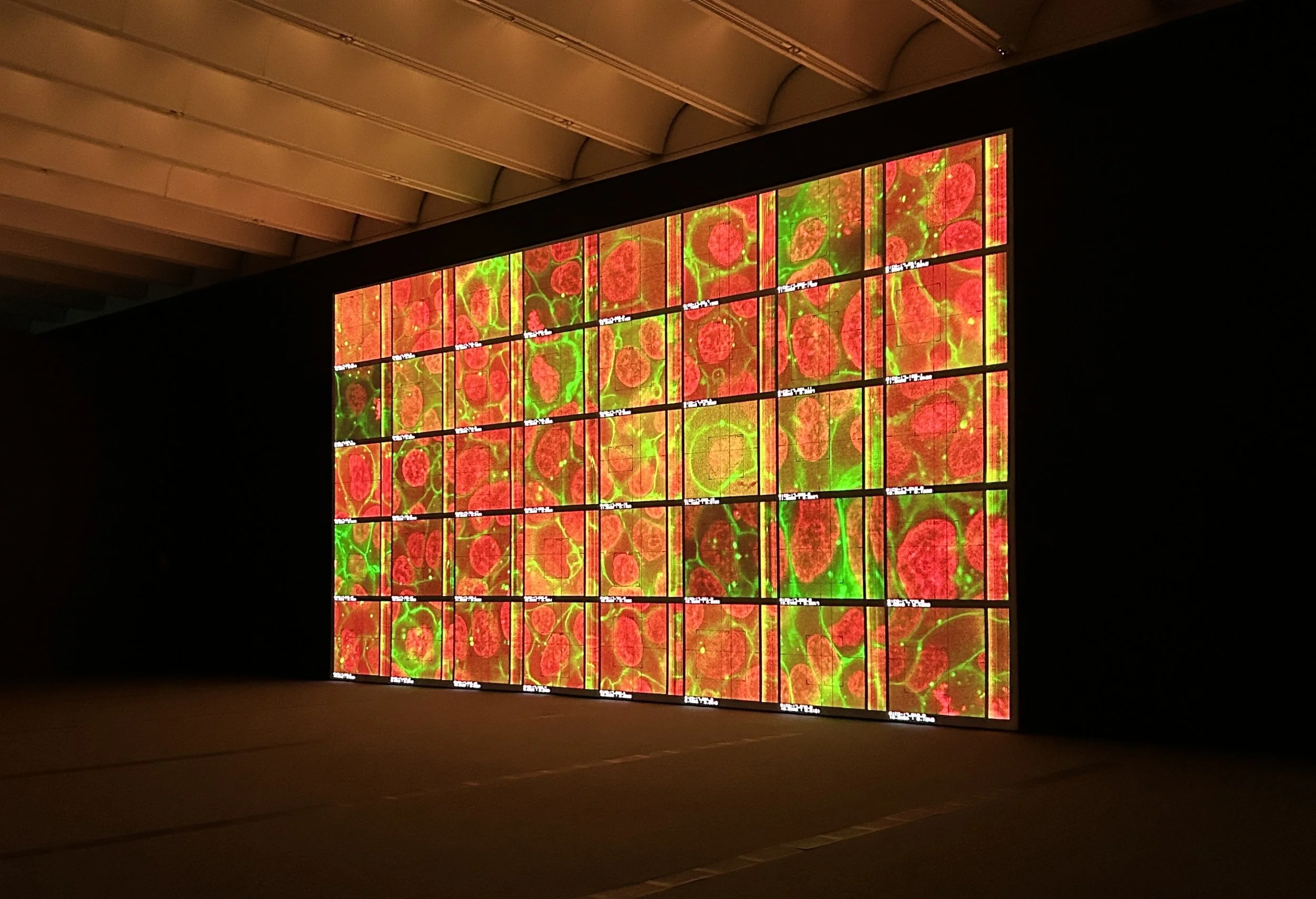
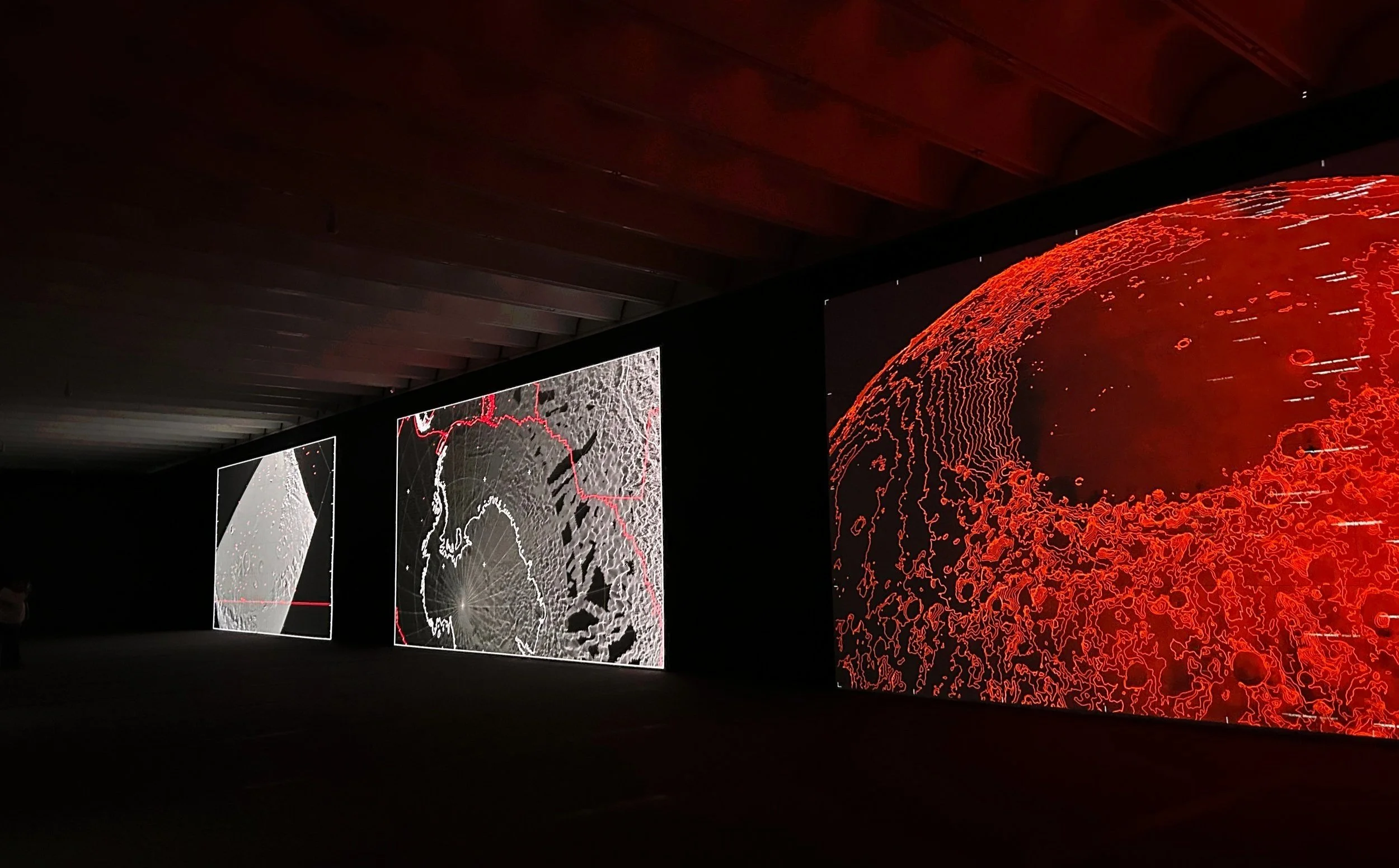
As an experience, data-verse is both engaging and humbling. The scale and the immersive nature of the exhibit will likely make it appealing to those who want to appreciate fine art, but find their minds wandering while staring at static pieces on a white wall (no judgement here). This is an exhibit overflowing with visual and auditory stimuli; even Gen Alpha might find it attention-worthy, for a few minutes at least. The three massive screens move rapidly through all sorts of data: nerve mapping of the human brain, galactic superclusters, hurricanes, stock market fluctuations, object recognition in security footage of garages and parking lots. The initial reaction is awe and maybe overwhelm, but after a moment, you’ll start to make your own connections (another form of data!): manmade and natural, galactic and human, the exhibit reveals how data intertwines everything. Whether it’s the intricate wiring of our brain, the choreography of an air traffic system, or the precision of our solar system, there is beauty and complexity in all things that function.
Ikeda is well-known for his music, which could be described as “sound” by some and “electronia” by others; here, it serves as another expression of the data. Pulsing pings, ambient drones, and mechanical hums bring the visuals to life, transforming raw information into a sensory experience. Is data alive? Nature would say so.
While you may be eager to rush through to get to the main event, take your time experiencing the first few, more minimalistic installations: “point of no return,” “mass” and “line,” which eerily recreative the sensation of seeing and entering a black hole. These set the stage for vast, hypnotic (and more photogenic) “data-verse 1/2/3”, reminding us of our smallness in comparison to the universe. You can stare into the abyss, but make no mistake, it’s staring right back.
Post “data-verse 1/2/3,” the exhibit features 2D prints that juxtapose darkness and brightness, death and birth, doing and being. One print titled “db” explores language as data — there’s enough material there for its own exhibit, but maybe that’s another day.
Ryoji Ikeda has stated “Humans are tiny like dust particles in the universe, but at the same time we are miraculously precious. We humans should be modest, because Nature made us, and we are part of nature.” Another juxtaposition, but hopefully one even humans can understand: your existence is a miracle, yet no more significant than anyone else’s.
Credit is also due to the programmers who sourced and compiled the massive amount of data on display: Norimichi Hirakawa, Tomonaga Tokuyama, Ryo Shiraki, and Satoshi Hama. Additionally, The High Museum does an exceptional job in their presentation of the exhibit and the materials accompanying it.
As made clear before entering, the exhibit contains loud, sudden noises and flashing lights and strobe effects. Those sensitive to seizures will need to be aware.
Ryoji Ikeda: data-verse is on display March 7 - August 10, 2025 at the High Musuem in Atlanta, Georgia.
